
Accelerated Weathering Testing: Methods, Materials & Why It Matters

Accelerated weathering testing is a method used to evaluate the damaging, long-term effects of environmental factors - primarily sunlight (radiant energy), moisture, and temperature fluctuations - on materials. Weathering can affect coatings, plastics, textiles, inks and printing, and architectural materials, ultimately degrading appearance, performance, and structural integrity.
Weathering is not limited to exterior applications. Indoor end-use materials such as paint, flooring, and automotive interior components can be subject to radiant energy from sunlight through windows or from artificial lighting, along with heat fluctuation and moisture cycling. The goal of weathering tests is to predict how a material will perform over its intended service life, ensuring product safety, durability, and appearance from development through end of life.
Types of Weathering Testing Methods
Outdoor (Natural) Weathering Tests
Natural outdoor weathering testing provides the most realistic evaluation of how products will perform in real-world conditions. Testing is generally conducted at benchmark locations with severe climates, such as South Florida (high UV and humidity) and Arizona (intense dry heat). Samples are mounted on exposure racks - sometimes fitted with reflectors to intensify solar radiation - and monitored for long-term performance, often over several years.

The primary drawback of natural weathering is test duration. For highly durable materials with long service lives, natural weathering alone is impractical as a product development tool.
Accelerated Weathering Tests (Laboratory)
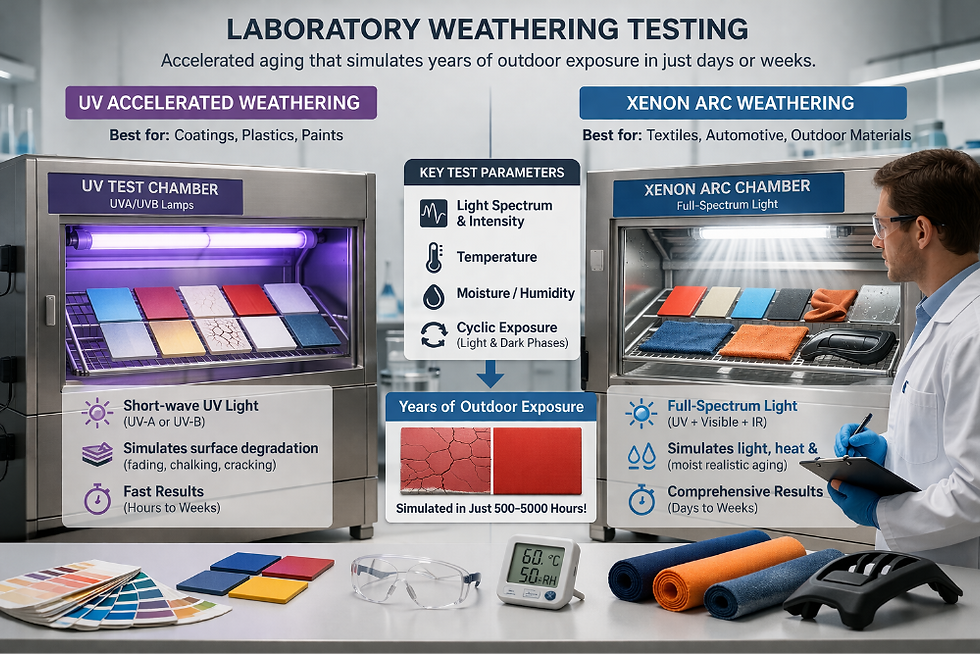
To reduce testing timelines, accelerated weathering tests are performed in specialized laboratory chambers that expose materials to intensified UV radiation, heat, and moisture. These tests are designed to simulate many years of outdoor exposure in a compressed timeframe - typically 500 to 5,000 hours.
The two most widely used accelerated weathering methods are UV accelerated weathering and xenon arc accelerated weathering. Both methods control the same core parameters: light spectrum and irradiance (intensity), temperature, and moisture/humidity. Tests also incorporate alternating light and dark cycles to replicate real-world day/night exposure patterns.
UV Accelerated Weathering
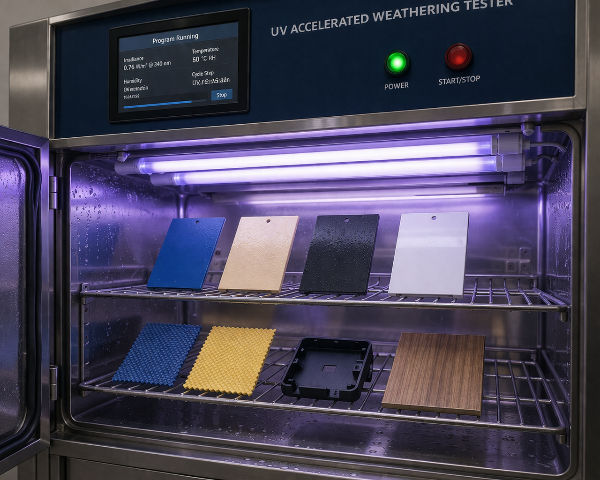
UV weathering chambers use fluorescent UV lamps - typically UVA-340 or UVB-313 - to simulate the short-wavelength, high-energy portion of the solar spectrum that is primarily responsible for photodegradation. This method is highly effective for assessing surface degradation such as color fading, chalking, and cracking on materials like coatings, plastics, and paints.
Common standards include ASTM G154 and ISO 4892-3. UV testing is ideal for materials where UV radiation is the dominant degradation driver, rather than visible or infrared light.
Xenon Arc Accelerated Weathering
Xenon arc weathering chambers use xenon arc lamps to produce broad-spectrum radiation that closely replicates full natural sunlight - including UV, visible, and infrared wavelengths. This makes xenon arc testing more comprehensive, accounting for the combined effects of light, heat, and moisture on a material.
Common standards include ASTM G155 and ISO 4892-2. Xenon arc testing is preferred for textiles, automotive components, and materials used in outdoor applications that are exposed to the full solar spectrum and require a holistic durability evaluation.
What Materials Are Commonly Tested?
Weathering tests are used to determine the long-term durability of a broad range of materials - from consumer goods to industrial infrastructure. Any material exposed to radiant energy, whether from sunlight or man-made lighting, can be affected over time.
Indoor Materials
Materials exposed to sunlight through windows or artificial lighting are subject to weathering even in controlled environments. UV and xenon arc weathering tests are commonly used to evaluate the following:
Architectural materials: carpet, vinyl laminate flooring, wallpaper, wall finishes, painted or powder-coated surfaces, wall paneling, molded trim, and decorative finishes
Textiles and soft materials: upholstery, curtains, blinds, cushions, and interior coverings
Electrical and electronics: enclosures, touchscreens, displays, and appliance housings
Sealing components: gaskets and seals
Labeling: labels and laminated surfaces
Plastics: ABS, PVC, acrylic, PP, and nylon components
Automotive interiors: dashboards, trim, seat materials, and door panels
Outdoor Materials
Direct sunlight, moisture, and extreme temperatures can rapidly degrade materials not specifically engineered for outdoor use. UV and xenon arc accelerated weathering tests simulate long-term outdoor exposure through intense UV radiation and aggressive wet/dry cycles. Commonly tested outdoor materials include:
Architectural materials: coatings, aluminum panels, roofing, siding, and sealants
Windows and doors: frames, gaskets, seals, and installation sealants
Automotive: coatings for plastic and metal parts, plastic components, and glass
Outdoor furnishings: fencing, furniture, and decking
Recreational vehicles: lighting, decals, coatings, trim, and plastic parts
Performance textiles: awnings, shades, pool covers, and sports apparel
Outdoor electrical devices: security cameras, keypads, locks, and outdoor lighting
Utilities and infrastructure: enclosures, cable jacketing, and fasteners
Summary
Weathering testing plays a critical role in ensuring materials maintain their appearance, performance, and durability throughout their intended service life. Both indoor and outdoor materials - from architectural finishes and coatings to plastics, textiles, and consumer goods - can be degraded by UV radiation, moisture, and temperature over time. UV and xenon arc accelerated weathering tests provide manufacturers with validated, data-driven confidence that materials will perform as expected.
About Assured
Assured Testing Services supports companies across the automotive, building and construction, appliance, coatings, and electrical/infrastructure industries. With extensive UV and xenon arc chamber capacity, ISO 17025 accreditation, and comprehensive materials testing capabilities, we deliver detailed, high-quality test reports with fast turnaround - testing typically begins within 48 hours of sample receipt. Contact us to discuss your weathering testing requirements.

Frequently Asked Questions
What is the difference between UV and xenon arc weathering tests?
UV weathering tests use fluorescent UV lamps to simulate the high-energy, short-wavelength portion of sunlight responsible for photodegradation - making them well-suited for coatings and plastics. Xenon arc tests use lamps that replicate the full solar spectrum (UV, visible, and infrared), making them more comprehensive for materials exposed to all aspects of natural sunlight, such as textiles and automotive components.
How long does accelerated weathering testing take?
Accelerated weathering tests typically run between 500 and 5,000 hours depending on the specification, material, and performance requirements. The compressed timeline is designed to simulate months or years of outdoor exposure.
What ASTM and ISO standards apply to weathering testing?
Commonly referenced standards include ASTM G154 and ISO 4892-3 for UV fluorescent weathering, and ASTM G155 and ISO 4892-2 for xenon arc weathering. Many industry-specific material and product standards reference these methods directly.
Which industries use weathering testing most?
Automotive, building and construction, coatings, textiles, electrical, and consumer products manufacturers all rely on weathering testing to validate material performance and meet specification requirements.


Comments